The Endnote Preface of Zen and the Art Motorcycle Maintenance Chris Dying

Writer Robert Pirsig and his son Chris in 1968. Pirsig, who wrote Zen and the Art of Motorcycle Maintenance, died Monday at age 88. William Morrow/HarperCollins hide caption
toggle caption
William Morrow/HarperCollins

Author Robert Pirsig and his son Chris in 1968. Pirsig, who wrote Zen and the Art of Motorcycle Maintenance, died Monday at historic period 88.
William Morrow/HarperCollins
Robert M. Pirsig, who inspired generations to road trip across America with his "novelistic autobigraphy," Zen and the Art of Motorbike Maintenance, died Monday at the age of 88.
His publisher William Morrow & Company said in a argument that Pirsig died at his home in South Berwick, Maine, "after a period of failing wellness."
Pirsig wrote just two books: Zen (subtitled "An Research Into Values") and Lila: An Inquiry into Morals.

Writer Robert Pirsig works on a motorbike in 1975. William Morrow/HarperCollins hide caption
toggle caption
William Morrow/HarperCollins
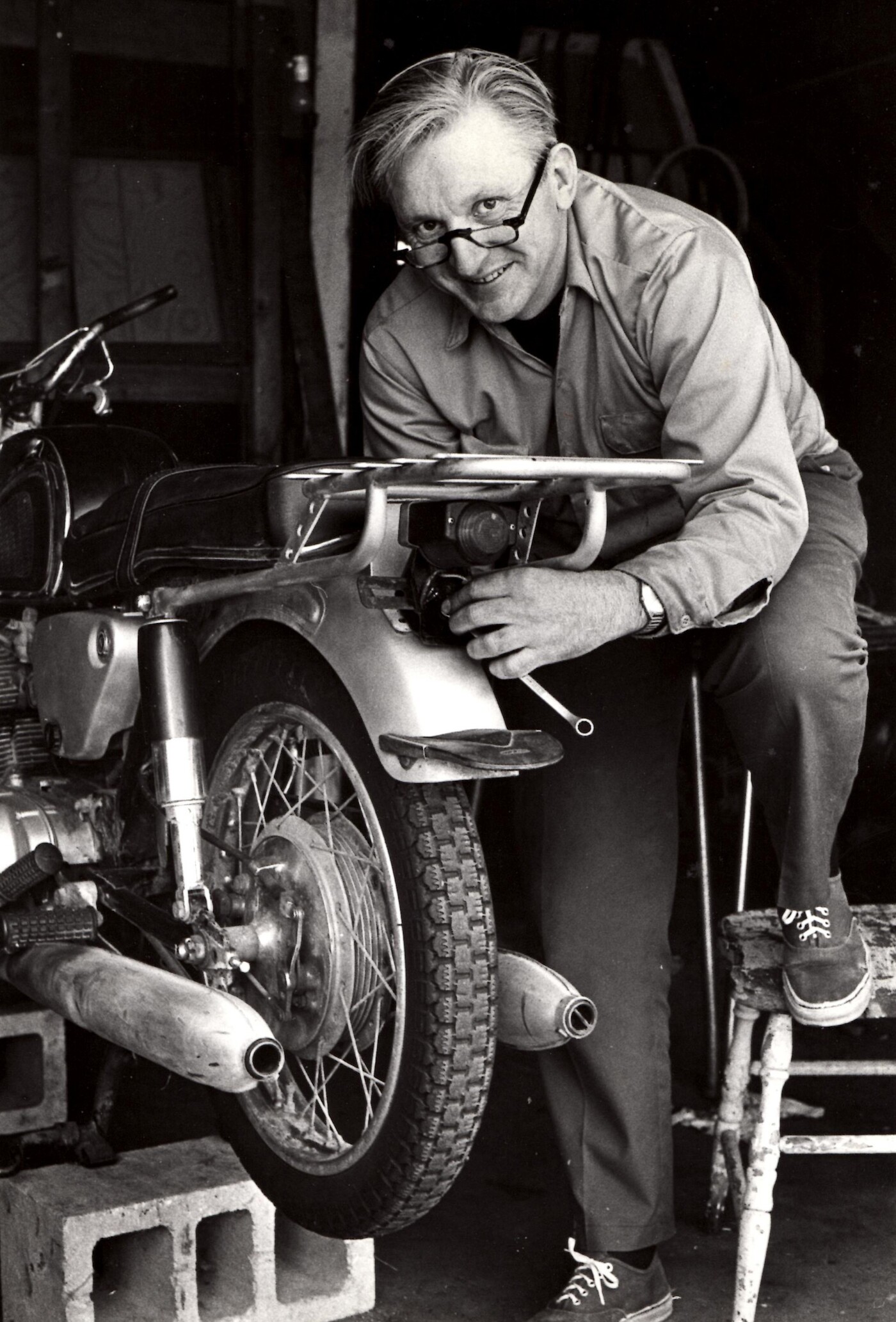
Author Robert Pirsig works on a motorbike in 1975.
William Morrow/HarperCollins
Zen was published in 1974, after beingness rejected by 121 publishing houses. "The book is bright beyond conventionalities," wrote Morrow editor James Landis before publication. "It is probably a work of genius and will, I'll wager, attain classic status."
Indeed, the volume quickly became a best-seller, and has proved enduring as a piece of work of popular philosophy. A 1968 motorcycle trip across the Due west with his son Christopher was his inspiration.
Christopher Lehmann-Haupt reviewed Zen for The New York Times in 1974. "[H]owever impressive are the seductive powers with which Mr. Pirsig engages us in his motorcycle trip, they are zippo compared to the skill with which he interests us in his philosophic trip," he wrote. "Mr. Pirsig may sometimes appear to be a greener‐America proselytizer, with his beard and his motorcycle tripping and his talk well-nigh learning to love technology. But when he comes to grips with the hard philosophical conundrums raised past the 1960's, he can be electrifying."
Pirsig was built-in in Minneapolis, the son of a University of Minnesota police force professor. He graduated from high schoolhouse at 15 and enlisted in the Army after World War Two. While stationed in South Korea, he encountered the Asian philosophies that would underpin his piece of work. He went on to study Hindu philosophy in Bharat and for a time was enrolled in a philosophy Ph.D. program at the Academy of Chicago. He was hospitalized for mental affliction and returned to Minneapolis, where he worked equally a technical writer and began writing his outset book.

Zen and the Fine art of Motorcycle Maintenance was ane of just two books that Pirsig wrote. It has endured as a work of popular philosophy. Alan Levine/Flickr hibernate explanation
toggle caption
Alan Levine/Flickr
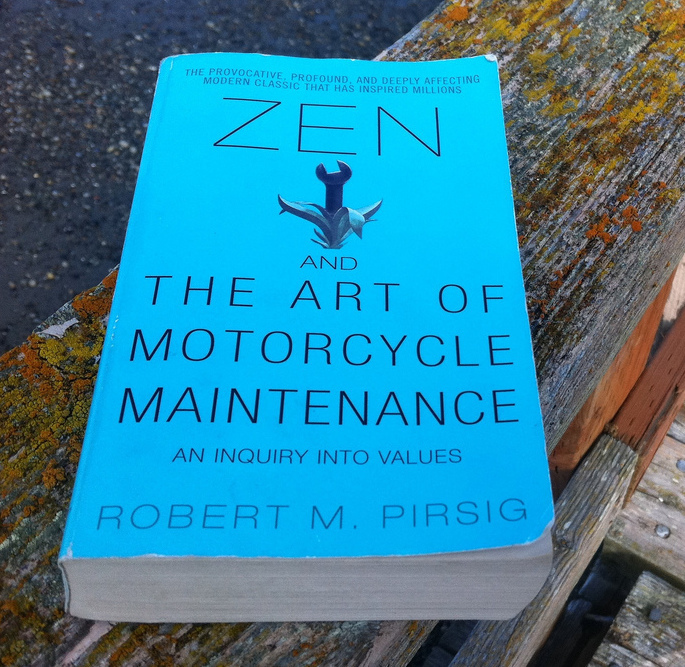
Zen and the Fine art of Motorcycle Maintenance was one of but two books that Pirsig wrote. It has endured every bit a work of popular philosophy.
Alan Levine/Flickr
Pirsig also helped found the Minnesota Zen Meditation Center, so lived reclusively and worked on Lila for 17 years before its publication in 1991. "A skilled mechanic, he performed repairs in his abode workshop," writes the publisher. "He taught himself navigation in the days before GPS, and twice crossed the Atlantic in his small sailboat, Aretê."
The protagonist of Zen attempts to resolve the conflicts betwixt "classic" values that create machinery like the motorcycle, and "romantic" values like the dazzler of a state road. He discovers all values observe their root in what Pirsig called Quality:
"Quality . . . yous know what it is, yet you don't know what it is. But that'southward self-contradictory. But some things are better than others, that is, they have more than quality. Merely when you try to say what the quality is, apart from the things that take it, it all goes poof! There'south nothing to talk about. But if you can't say what Quality is, how do you know what it is, or how practice you know that information technology even exists? If no one knows what information technology is, then for all practical purposes information technology doesn't exist at all. But for all practical purposes it really does exist."
Source: https://www.npr.org/sections/thetwo-way/2017/04/24/525443040/-zen-and-the-art-of-motorcycle-maintenance-author-robert-m-pirsig-dies-at-88
0 Response to "The Endnote Preface of Zen and the Art Motorcycle Maintenance Chris Dying"
Post a Comment