Preschematic Stage of Art Stages of Art Development in Early Childhood
 Mind to this
development
Child art: A brief review of the developmental stages
Peggy Pat Martin
The purpose of this article is to review briefly the developmental stages of children's art from ages ii to fourteen and to offer a few suggestions for activities and materials relative to those stages, as an aid to providing confident and creative child care in art therapy and related areas. In her book, The Artist In Each of U.s.a., Florence Cane states that ... what we need to be taught is non art, but to believe in ourselves, our imagination, our senses, and our hands, to gratis our bodies and our spirits that nosotros may work and alive according to our visions ... From failures and victories come up skill, and skill itself is technique.
The goal in providing art activities for children is not to train artists but to offer opportunities for cocky discovery and self subject field and then children may relate to their environment as healthy and integrated individuals.
Developmental stages
Essential to sensitive guidance in planning and executing the programme is knowledge of what to expect and what not to expect of children. Past understanding normal development in child fine art, a basis of comparison is provided by which we are able to evaluate deviations in children who are experientially deprived, emotionally disturbed, mentally retarded, deaf, or blind.
Extensive, documented studies of kid art in previous and present cultures indicate that children (and adults with delayed experiences) grow through a series of predictable developmental stages in their drawings and paintings; recent studies involving play with clay also propose like patterns be therein.
The three major stages take been descriptively named
1. Scribble
2. Schematic (from the Latin word schema meaning outline)
3. Realistic or Truthful-to-Appearance
These stages reflect the overall growth and development of the kid between about 2 and fourteen or more years. Child art is acknowledged to be uniquely unlike from adult art. A child begins to draw as a normal part of his attempt to explore, to manipulate, to seek order, and to control himself in his environment. Children who are appropriately encouraged along developmental patterns tend to achieve a college level of skill. The majority of adults today take not attained a level of competence beyond the schematic stage due largely to lack of sympathetic stimuli. The adult who has not achieved the skill to draw representational realistic forms oftentimes feels he tin can't describe a direct line.
Scribbler stage
The Scribbler (from about age two through v) initially sees no connection between the crayon in the manus and the mark on the paper as he embarks on his initial uncontrolled manipulation; cartoon is a motor activity � an extension of bodily movement which can go expressive of feelings and later, of ideas. Rhoda Kellogg has identified twenty basic scribbles children use most often, fabricated of lines that are vertical, horizontal, diagonal, round, curving, and waving, as well as dots; these scribbles are applied in primarily seventeen major patterns.
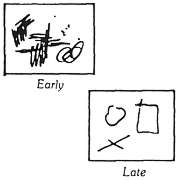
After considerable practice, rudimentary linear forms are attained which may exist chosen pre-schematic: circles, ovals, triangles, rectangles, squares, crosses, and X's. Varied cornbina tions of these forms result in the child'southward discovering universal designs which accept been used in every primitive culture �the lord's day, mandala, and radial. During early scribbling (and sometimes into the schematic state), colour is used emotionally, i.e., the kid uses whatever he likes best or what is in closest proximity to him; there is not relationship to colour in real life. Numerous colours are enjoyed; well-nigh oft four or more are used in one drawing. Commonly carmine, xanthous, blue and green are favourites. Children brainstorm to proper noun drawings as they complete them. A prove and tell time offers insight into what the child is feeling and thinking at the moment. �Tell me about your picture" is a better arroyo than �What is that?" be cause the latter could exist interpreted equally a failure to draw well enough to communicate the intended feeling or idea. �I" and �my" are prominent in vocabulary. Drawings show trivial individuality until the child moves into the Schematic stage.
Schematic stage
We know the child is in the Schematic state (virtually five through nine) when his linear drawings tin can be identified as definite shapes of specific, recognisable forms, due east.one thousand. a man or a house. His primary interest is in people; his human schema will be drawn uniquely and personally; his schema tin be recognised from that of other children; the details within it reverberate his own cocky-awareness. (Use of colouring books tends to destroy a child's conviction in his own schemata.) His desire for developed and cocky approval become more acute as this stage develops. Forepart face views precede profiles.
Size is related to importance, so what is virtually interesting to him may exist largest.
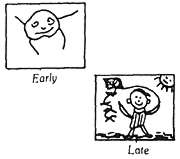
Favourite subjects are humans, houses, and plants; others are animals, trains, cars, airplanes, recreation, games, and amusements. Early schemata (linear forms) are drawn equally if floating all over the page in odd positions � a table may be fatigued circular as if seen from above; people seated at the table may exist extended out in all directions effectually it.
Afterward schemata are related to a baseline at the bottom of the flick or to multiple baselines covering the folio from superlative to bottom. The baseline is highly significant in indicating readiness for co-operative play and thinking, such as planning and executing group murals and puppet shows.
Using a line across the top and a baseline at the bottom, with air in between, is a further evolution. Houses and people are often transparent.
Colours are used to fill in and enrich the linear schema and begin to exist related to real life, that is, the grass and trees are greenish, the sky is bluish, the apple tree is red. Cherry-red and blue are favourite colours. Drawings are based on memory of things rather than actual appearance, and may incorporate sensory impressions about smelling, tasting, hearing and feeling.
Realistic stage
As the child perceives more of reality and becomes more skilful in expressing what he sees, knows, and feels, he commonly proceeds into the
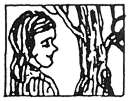
True-to-Appearance stage (well-nigh ix through fourteen years or older). Realism mostly begins along with early on adolescence, and the kid who indicates less co-operation with adults may exist guided into cooperative thinking by using themes of people helping one another. Peer planning and group executing of activities is now enjoyed more than. More details are perceived and drawn; drawings show girls in skirts and boys in long pants. New spatial concepts include overlapping and receding planes and, later, the use of linear perspective. Subtle shading of form replaces simple, flat areas of colour; tints and shades of color are more preferred.
Around fourteen years and over, monochromatic colour is often used; colour is used to express moods and feelings and to portray actual true-to-appearance colour.
Favourite subjects are houses, ships, plants, and people; other subjects may include animals, insects, fish, vehicles, weapons, and landscapes. Interest in drawing the homo head supersedes drawing the drawing entire figures when the skills of eye-hand coordination practise not keep up with the child's power to run into realistically.
(An aware teacher can stimulate lively sessions in which children pose for one some other as an aid to overcoming this trouble.)
Every bit the realistic stage progresses, the adolescent tends to draw in ane of two ways:
-
he perceives and executes work with an emphasis on the visual, exteriorview of things; or
-
he expresses himself on a feeling or subjective level dealing with muscular sensations and touch impressions and so that the forms he draws may seem distorted in appearance.
Special children
The preceding review of the stages of development in the art of normal children provides a basis for understanding what to expect of special children. The evaluation of children from a few isolated drawings is not recommended for inexperienced persons. A valid evaluation can exist made by collecting daily spontaneous pictures in a personalised binder. Date each work; record significant verbalisations the child makes nigh the work. (These can exist noted on back of the moving-picture show.) These go a office of a permanent record of growth and change. Past using such a portfolio, and past observing spontaneous fine art sessions where free choice of materials and subjects are offered, a child care worker tin can acquire to determine the developmental level of each child.
It is useful to know that a child may draw amend with crayon than with chalk because he has used it more oftentimes; fifty-fifty adults must get through an exploratory, manipulative period when they first endeavour a new medium earlier using it with the skill of their normal level of competency.
An emotionally disturbed child who has been deprived of normal artistic expression due to temporary organic dysfunction, parental neglect, or emotional inhibition may progress expediently toward the developmental level of his normal chronological historic period if provided with materials and sympathetic motivation, in an atmosphere conducive to free, personal growth. A disturbed kid who is withdrawn, frightened, or angry may exist encouraged toward credence of self and the surrounding surround through appealing, feely fun, bear on experiences in simple fine art activities, handling and manipulating materials like dirt, finger paint, or collage.
Mentally retarded children develop more slowly than normal ones. For them, fine art stages occur later and require more extended time to develop. The content of their work may reflect the interests of their chronological age. The adolescent slow learner with an I. Q. of at least 70, no thing what his grade level, tends to employ some of the discipline matter institute in the art piece of work of the normal adolescent. An boyish in this category is interested in social events at which both sexes are present. Boys like to portray sports, daring deeds and mechanical objects. In general, the retarded kid cannot cope with complex tasks merely can happily piece of work at projects like to those of his peers �tasks which tin exist geared to run across the mental historic period of younger children. Their pictures may lack motion or rich item, and tend to be more stereotyped with more misconceptions in proportions of forms.
Their compositions oftentimes lack unity, a centre of interest, or texture. Their use of line and colour is successful, though colour is pure and seldom mixed. Art provides the retarded child with an opportunity for successful achievement on his own level, and he volition oftentimes sustain interest in an art activeness afterwards normal children take expended their interests elsewhere.
Studies show that pictures past deaf children are especially rich in details, due to acute visual memory, but comprise fewer people or animals and social interactions. They often depict cruelty and violence; thus, fine art may be exceptionally important as a mode for them to express feet, fright and frustration resulting from their condition of isolation.
When blind children have been taught to describe successfully with a Braille technique, the forms they produced lack item and resemble those of much younger children. In general their expressions are based on feelings, in that they project entirely an inner world of tactile and bodily sensations. Clay has been used frequently by the blind of all ages; schema are arrived at past feeling and touching selves and objects. Work is fabricated past combining many bits of clay in an additive construction. Tactile activities of etching, modelling, tooling foil and leather, collage and mosaics, painting and finger painting appeal to blind children. Since these children develop a not bad sense of hearing, music and other sounds can enrich their art experiences greatly. Rhythm, movement and line may be perceived through sounds and translated into visual expressions.
Conclusion
In summary, children's art follows a sequential blueprint of growth and development. The art of each child reflects his level of self awareness and the degree to which he is integrated with his environment.
Children may exist encouraged to exist perceptive, imaginative, and artistic when they are guided by knowledgeable, sympathetic persons who let them freedom to limited ideas, feelings, and fantasies in a style advisable to their developmental level and ability. This sort of freedom is nurtured in an atmosphere of acceptance where children are provided with a time, a place, suitable materials, and an idea motivated from the child'due south own world or experience and feelings. The attitude of the adult or teacher ... must be one of willingness to submerge his own witting, rational mind and hold it in check while the student's perceptive, imaginative, and emotional self is given complimentary reign. Artistic expression requires a kind of moral courage �a spirit of run a risk, a play instinct, an ability to take a modify. One must non only exist fearless of his environment, just the environment itself must also exist warm, encouraging � and inviting.
Kid Care Work in Focus, copyright the Academy of Child and Youth Care Practice
0 Response to "Preschematic Stage of Art Stages of Art Development in Early Childhood"
Post a Comment